
What Happens If You Lose a USB Drive?
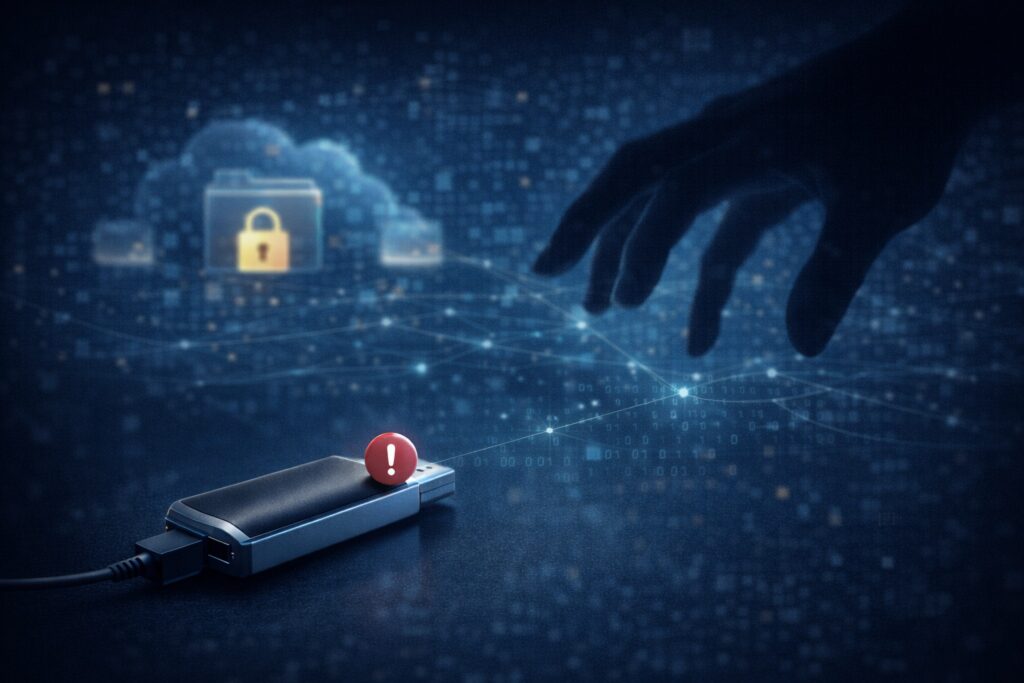
The Problem Is Not Losing the Device
Most people believe losing a USB drive is a minor inconvenience.
“I don’t store anything important on it.”
“Who would even bother opening it?”
“It’s probably fine.”
This assumption is dangerously optimistic.
The real risk is not losing the device.
The risk is what happens after it is found.
A USB Drive Assumes Trust by Default
Traditional USB storage follows a simple security model:
-
Data is stored in plain form
-
No authentication is required
-
Anyone who plugs it in can read the contents
The moment a USB drive connects to another computer, access is granted automatically.
There is no warning.
No log.
No second chance.
Why USB Data Loss Is Irreversible
When a phone is lost, you can lock or wipe it remotely.
When a cloud account is compromised, you can revoke sessions or reset credentials.
A lost USB drive offers none of these options.
-
No remote control
-
No revocation
-
No recovery
Once the device is gone, the outcome is permanent.
Why “Just Encrypt It” Rarely Works in Practice
Many users know encryption is important.
Few use it consistently.
Manual encryption introduces friction:
-
Extra steps
-
Poor usability
-
Files that become harder to access over time
As a result, encryption is often skipped—especially for files that are accessed frequently.
Convenience quietly overrides caution.
Mobilink Solves the Problem at the Design Level
Mobilink removes the need for manual decisions.
-
Files are encrypted before being written to external storage
-
Encryption is tied to authorization, not the device itself
-
Without approval, the data cannot be decrypted
If a USB drive is lost, the data remains unreadable.
Physical possession no longer equals access.
Why Plugging Into Another Computer Should Not Work
This is not a restriction.
It is a correction.
In the Mobilink model:
-
Storage devices do not trust environments by default
-
Authorization is required, even on familiar machines
-
Data remains isolated from the host operating system
A found USB drive becomes a meaningless object, not a data leak.
Security Should Not Depend on Perfect Behavior
Most data breaches are not caused by malicious intent.
They are caused by ordinary mistakes.
Devices get lost.
Drives are forgotten.
People are human.
Mobilink assumes this reality and designs around it.
The Real Lesson
Losing a USB drive is a probability problem.
Losing your data is a design problem.
When data is encrypted, isolated, and bound to authorization—not possession—
loss no longer equals disaster.
Related reading:
Why Your Data Must Stay on Your Own Devices