
Data Isolation Is the Security Ordinary Users Actually Need
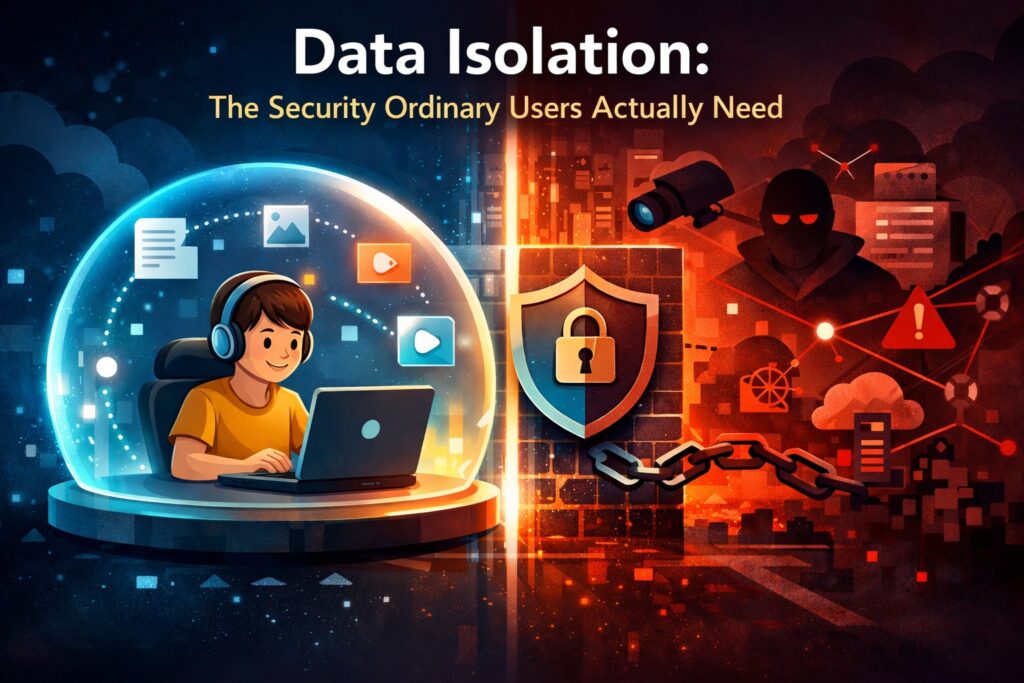
Security Is Not About Complexity
When people talk about “security,” they often think of:
encryption algorithms, key lengths, zero-trust frameworks, complex configurations.
But for ordinary users, security does not equal complexity.
The real question is far simpler:
Are my data kept away from systems, apps, and platforms that never needed access in the first place?
That is the core value of data isolation.
The Real Risks for Ordinary Users
Most real-world risks do not come from cryptographic failure, but from everyday defaults:
-
Files and photos being automatically synced
-
Multiple apps sharing the same file permissions
-
Data being cached, backed up, and indexed indefinitely
-
One-time authorization becoming persistent access
In these cases, data is not stolen—it is exposed by design.
For users, the real concern is not:
“Can someone break my encryption?”
But rather:
“How many systems can access my data without me realizing it?”
The Value of System-Level Isolation
Data isolation does not solve a “strength problem.”
It solves an exposure problem.
Effective isolation means:
-
Data does not enter unnecessary systems
-
Files are not centrally hosted
-
Permissions are not inherited forever
-
Connections expire automatically
In practice, preventing unnecessary access is often more valuable than increasing cryptographic complexity.
Mobilink’s Default Security Model
Mobilink does not attempt to reinforce a risky architecture.
It removes unnecessary risk at the structural level.
Its default model is based on:
-
Peer-to-peer connections only
-
No server storage, no retention
-
Connection equals permission
-
Session-based access that expires by design
Security does not depend on users configuring advanced options.
It is enforced by default behavior.
Why This Is the Security Ordinary Users Need
Most users should not be expected to understand security models.
They should not need to manage complex permissions or policies.
What they need is simpler:
-
No silent uploads
-
No persistent storage
-
No invisible access
-
No unnecessary intermediaries
Data isolation reduces cognitive burden, not just attack surface.
Security Starts with Design
Real security is not added later.
It begins with a foundational question:
Which data should never enter the system at all?
When isolation is the default,
security becomes something users benefit from—
without having to think about it.