
If You Already Own USB Drives and External Hard Drives, You Already Own a NAS
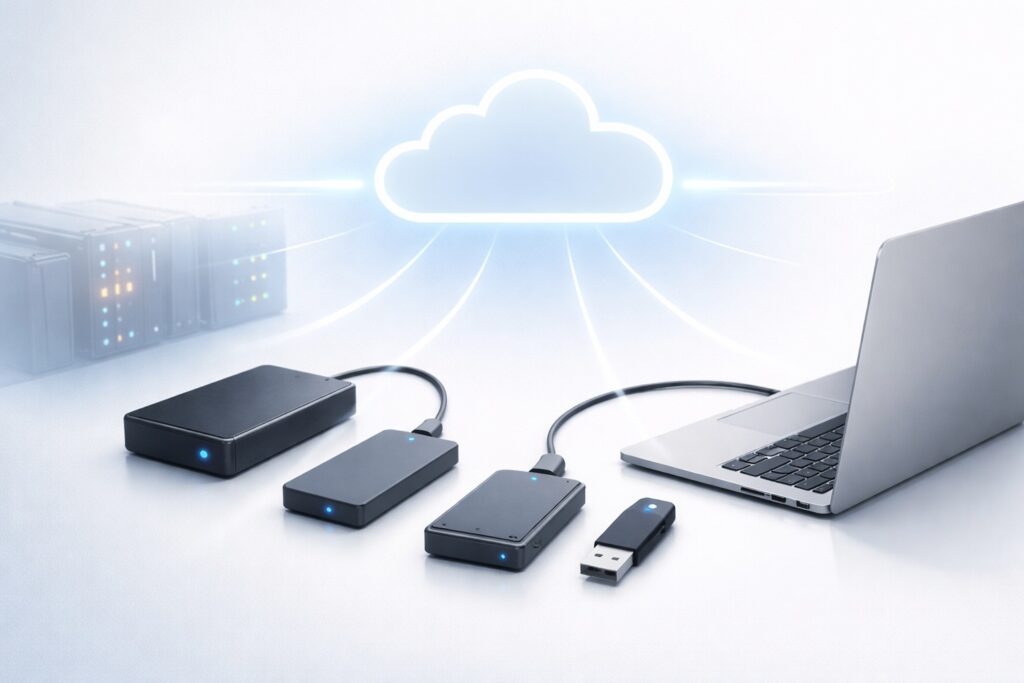
Most people think NAS starts with buying a box.
In reality, for millions of users, the most expensive part of a NAS system is already sitting in drawers, backpacks, and desk drawers—unused.
USB flash drives. External hard drives. Portable SSDs.
The problem is not a lack of storage.
It is a lack of capability.
The Overlooked Storage You Already Own
Over the past decade, storage has quietly accumulated.
People own:
-
Multiple USB flash drives from work, events, and backups
-
One or more external hard drives for photos, videos, or archives
-
Portable SSDs used occasionally, then forgotten
Collectively, this represents terabytes of idle storage capacity.
Yet most of it is treated as disposable, offline, or inconvenient—simply because it lacks connectivity and access control.
Why This Capacity Is Being Wasted
External storage is not underutilized because it is slow or unreliable.
It is underutilized because:
-
It is bound to physical presence
-
It requires manual plugging and unplugging
-
It cannot be accessed remotely
-
It has no identity, permissions, or network awareness
Without software, storage remains passive.
And passive storage cannot behave like a system.
NAS Was Never About the Disks
A common misconception is that NAS works because it uses “better” disks.
It does not.
NAS works because it provides:
-
A persistent software layer
-
Network connectivity
-
Identity and permission management
-
Secure access protocols
The disks themselves are not special.
The software is.
This is why buying more storage alone never turns external drives into a usable private cloud.
Software-Defined Storage Changes the Equation
Mobilink applies a software-defined storage model to everyday external drives.
Instead of forcing users to:
-
Buy dedicated NAS hardware
-
Reformat disks
-
Learn storage operating systems
Mobilink enables existing storage to become:
-
Addressable
-
Authenticated
-
Encrypted
-
Securely accessible across networks
Your USB drive stops being a file container.
It becomes a storage node.
This architectural approach is explained in detail in Turn External Storage Into a Real Private Cloud.
Low-Cost Private Cloud, Already in Your Hands
With Mobilink, the private cloud does not begin with purchasing hardware.
It begins with:
-
A computer you already use
-
External storage you already own
-
Software that adds identity, access, and security
There is no need for:
-
RAID arrays
-
24/7 servers
-
Network configuration or port forwarding
You gain remote access and private ownership without turning your home into a data center.
The Hidden Shift: Ownership Without Infrastructure
Traditional thinking says:
“To own your data, you must run infrastructure.”
Mobilink proves the opposite:
“To own your data, you only need control—not complexity.”
By separating storage ownership from infrastructure burden, existing external drives become enough.
The architecture behind this model is detailed here:
→ How External Storage Becomes a Private Cloud
Conclusion
If you already have USB drives and external hard drives, you are not missing hardware.
You are missing the software layer that allows storage to:
-
Participate in a network
-
Enforce permissions
-
Be accessed securely from anywhere
Once that layer exists, the distinction between “external drive” and “NAS” disappears.
You already own the storage.
Mobilink makes it usable.