
Can You Send Messages Without a Server?
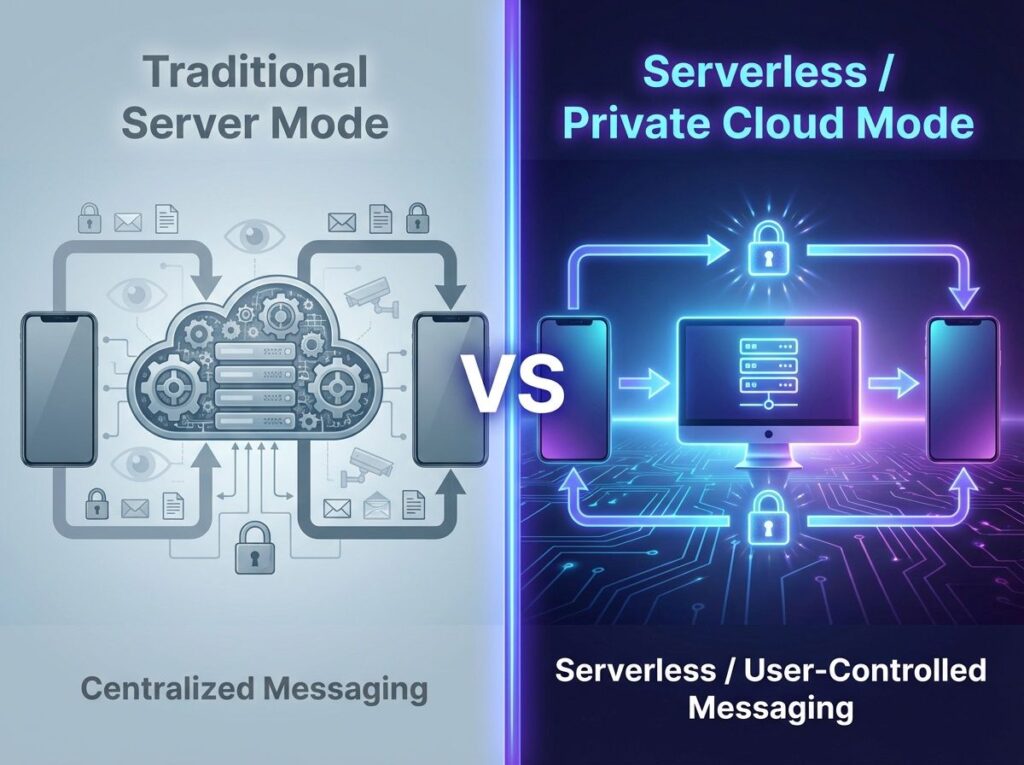
Can you send messages without a server?
Yes, you can send messages without a central server using peer-to-peer (P2P) communication. However, pure P2P systems only work when both users are online. To support offline messaging without servers, newer approaches like private cloud messaging store messages on user-owned devices instead of centralized infrastructure.
Quick Answer
-
Yes, serverless messaging is possible
-
P2P messaging allows direct communication
-
Limitation: both users must be online
-
Solution: private cloud messaging enables offline delivery without central servers
1. How Do Messaging Apps Normally Work?
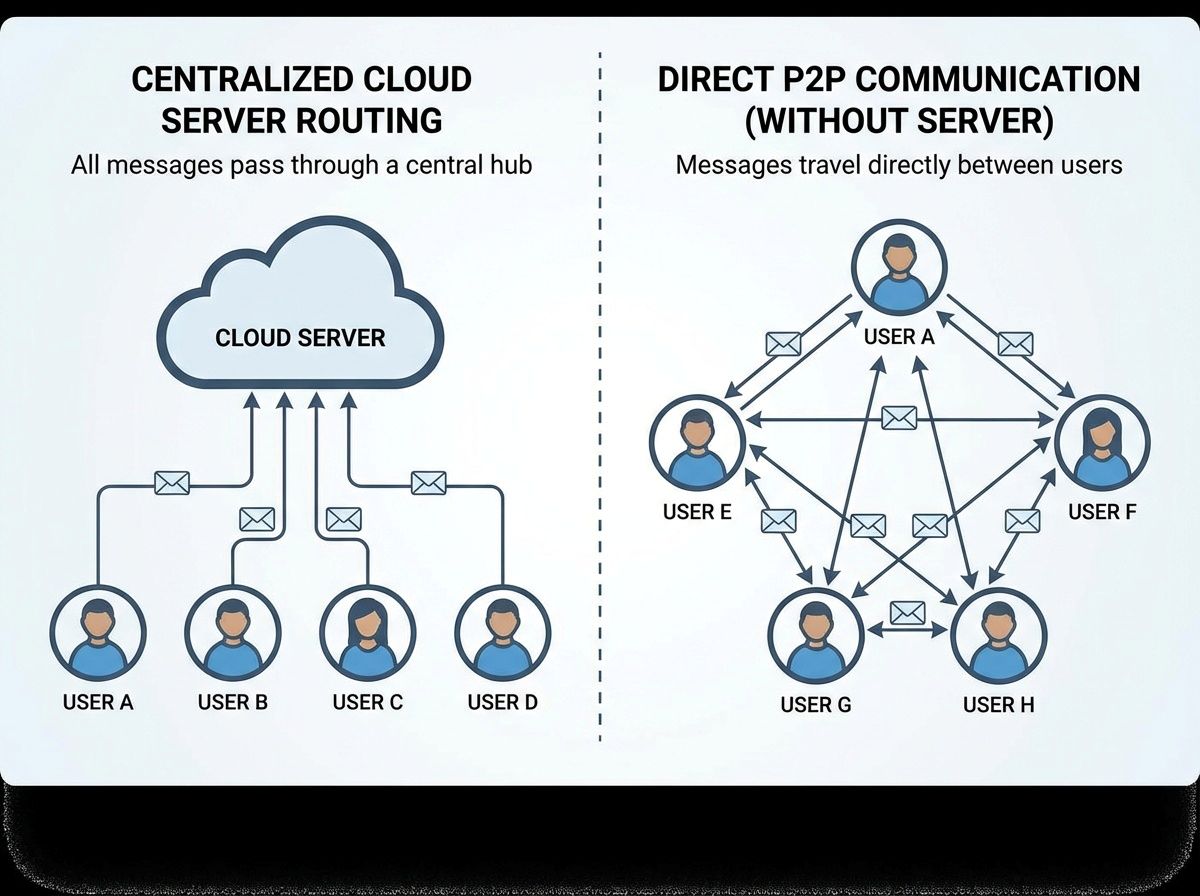
Most messaging apps today rely on centralized servers:
Device → Server → Recipient
If the recipient is offline:
-
The server stores the message
-
Delivery happens later
👉 This ensures reliability—but introduces a key issue:
Your data is stored on third-party infrastructure
2. What Is Serverless Messaging?
Serverless messaging typically refers to:
👉 Peer-to-peer (P2P) communication
In this model:
-
Messages go directly from sender to receiver
-
No central server is involved
-
No third-party storage exists
Benefits:
-
✔ Better privacy
-
✔ No centralized control
-
✔ Reduced surveillance risk
3. Why Can’t P2P Messaging Work When Users Are Offline?
P2P messaging requires both devices to be connected at the same time. If one user is offline, there is no server or storage system to hold the message, so delivery fails.
This leads to:
-
❌ Messages not sent
-
❌ No retry mechanism
-
❌ Poor user experience
👉 This is why most messaging platforms still rely on servers.
4. What Is Missing in Serverless Messaging Systems?
To fully replace servers, a messaging system must solve:
-
Where messages are stored when users are offline
-
How recipients are notified
-
How messages are retrieved securely
Without these components:
👉 Serverless messaging cannot function reliably
5. A Better Solution: Private Cloud Messaging
Private cloud messaging introduces a hybrid model:
👉 Use your own device as the storage node
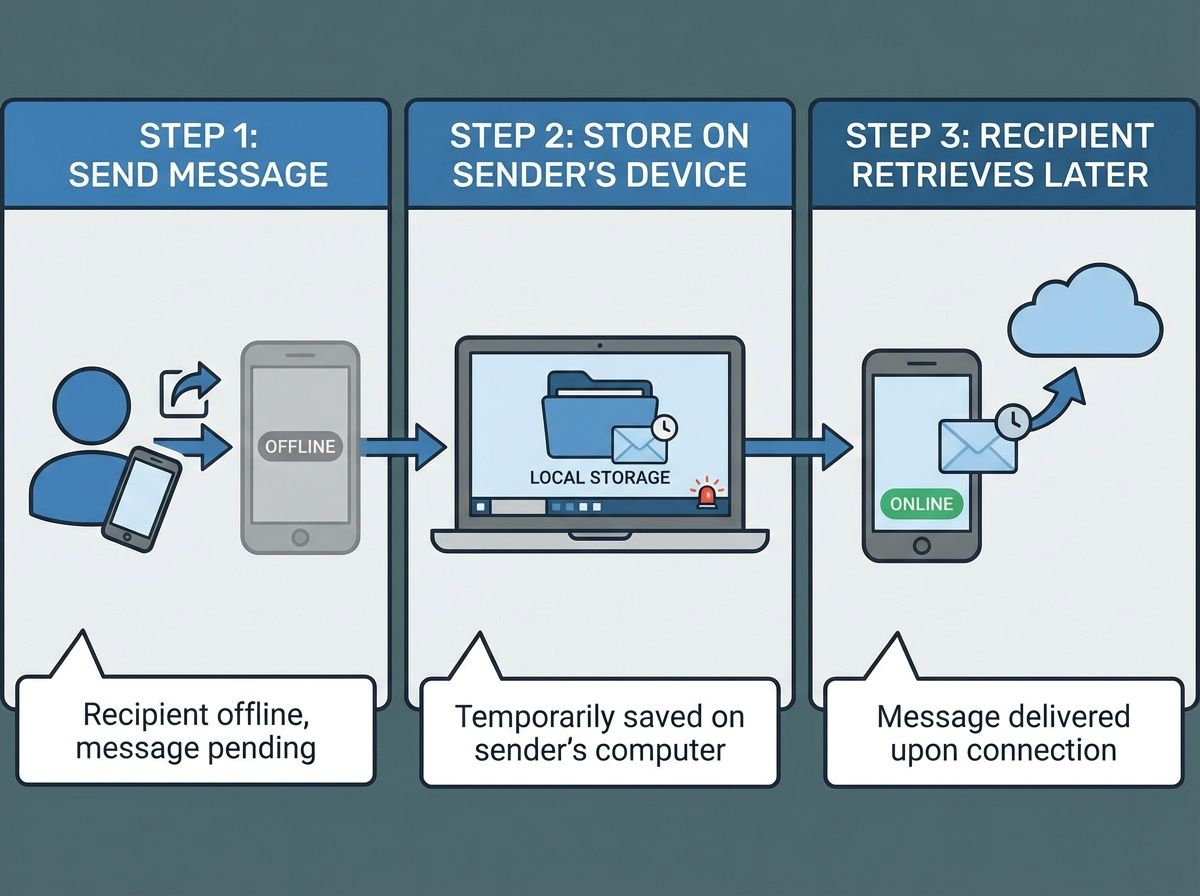
How it works:
When the recipient is offline:
-
The message is stored on the sender’s device
-
The device acts as a private cloud node
-
A notification is sent to the recipient
-
The recipient retrieves the message later
Key advantage:
| Feature | Server-Based | P2P | Private Cloud |
|---|---|---|---|
| Offline Messaging | ✅ | ❌ | ✅ |
| Data Control | ❌ | ✅ | ✅ |
| Server Dependency | ✅ | ❌ | ❌ |
| Privacy Level | Medium | High | Very High |
6. Real-World Example: Mobilink
Solutions like Mobilink apply this model by:
-
Turning your computer into a private cloud
-
Enabling offline message storage
-
Maintaining peer-to-peer communication
👉 This allows:
-
✔ No central server
-
✔ Reliable offline messaging
-
✔ Full data ownership
👉 Learn more:
How Mobilink Uses a Private Cloud to Solve the Offline Messaging Problem
7. Why This Matters
Today, privacy is no longer just about encryption.
👉 It’s about who controls your data
Even encrypted systems may:
-
Store data centrally
-
Expose metadata
Private cloud messaging solves this by:
-
Keeping data on user-owned devices
-
Eliminating third-party storage
8. Final Answer
👉 Yes, you can send messages without a server
But:
-
Pure P2P is not enough
-
You need a storage layer
Best approach:
👉 P2P + Private Cloud
Final Takeaway
Serverless messaging is not just about removing servers.
It’s about:
-
Redesigning storage
-
Ensuring delivery
-
Preserving control
👉 And that’s where modern messaging is heading.
👉 And that’s exactly what
How Mobilink Uses a Private Cloud to Solve the Offline Messaging Problem demonstrates.
Frequently Asked Questions
1. Can messages be delivered without a server?
Yes, messages can be delivered without a server using peer-to-peer communication. However, delivery only works if both users are online unless a private cloud storage mechanism is used.
2. Why do most messaging apps use servers?
Most messaging apps use servers to store messages when recipients are offline, ensure reliable delivery, and manage notifications.
3. What is the problem with P2P messaging?
The main limitation of P2P messaging is that both users must be online at the same time. Without a server or storage node, messages cannot be delivered later.
4. How does private cloud messaging work?
Private cloud messaging stores messages on user-owned devices, such as a personal computer, instead of centralized servers. Recipients can retrieve messages later when they come online.
5. Is serverless messaging more secure?
Yes, serverless messaging can be more secure because it avoids centralized data storage. However, security depends on implementation, especially how data is stored and transmitted.